Tuesday, April 24, 2012

The Fifth Conversation - Cars

Despite living in Michigan for essentially my entire life, I just don't do cars. I like them and all and I enjoy driving, it's just that everyone there knows far more about cars then I do. It's the auto state of the nation, the home of both Ford and GM and more of their employees than you can possibly imagine. A true Michigander can talk about cars for longer than most normal people can stay awake on an average day. My older brother prides himself on being able to identify the make and model of a car based on its headlights in the dark. There's no way I could do that. I can barely tell the difference between a Honda and a Chrysler.

So when Bandar started off our conversation today by talking about cars, I felt completely out of my element. He said he was looking at buying a car and wanted to know which one had the most easily replaceable parts. Not the most cost effective, not the one with the best gas mileage, not the safest, not the fastest, no. Why was this the most important attribute in Bandar's mind?

I asked and he said that at least in Saudi Arabia when a car part breaks it can take weeks or months to get it replaced, all depending on the type of car. Surely, I asked, that still wasn't as important as gas mileage. Replacing parts only matters when something breaks, but gas mileage matters every time you have to fill up your car with gas! But in Saudi Arabia, of course, gas isn't as expensive. It's an oil nation and the cost isn't nearly as inflated as it is here.
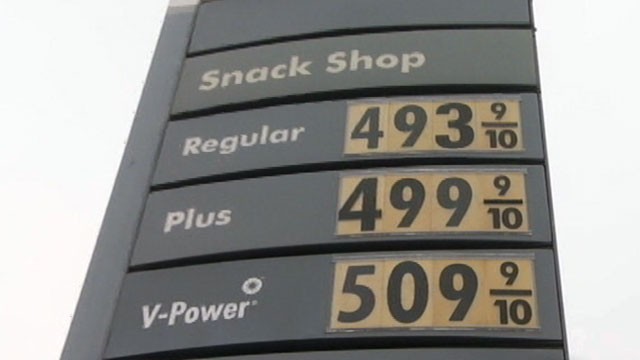
Gas prices in the United States are pretty high!
It made sense, but when I asked Bandar just how expensive gas was in Saudi Arabia I certainly wasn't ready for the numbers he tossed at me. While in American it might take 45 or 50 dollars to fill up a car's gas tank it would be a mere 7 dollars across the pond in Saudi Arabia. I sat there in stunned silence as Bandar thought for a moment and then amended his statement to the even lower $5.50 or $6. I could hardly believe it.

He went on to joke that if the rest of the world ever found a reasonable alternative energy supply, his country's economy would tank. At least, Bandar laughed when he said it, but I'm not so sure it was a joke. Without the country's oil exports there'd be no money for a lot of things, most notably the scholarships paid to students studying abroad. Students like Bandar. I was reminded of my own state, devastated when its powerful car manufacturers went under and had to lay off so many employees. To this day, the economy hasn't recovered.

Over our weeks of conversation, Bandar and I have talked about a lot of differences between our countries. We've considered the differences in laws, in city types, in jobs, in education, even the difference between our driver's licenses (in Saudi Arabia your license doesn't act as an I.D., you need a separate card), but nothing drove home the point quite like this discussion about oil. I don't know why knowing the gas price in Saudi Arabia had such an effect, but it did.

It almost seems like a fairy tale I'd sarcastically tell: "Once upon a time, in a land far away, you could fill up your car's gas tank for only seven dollars. And everyone was rich because they spent so little on gas. And they were happy. The End."

Our countries really are incredibly different places. We come from wholly different backgrounds, different cultures, different families, different climates, and even places with drastically different gas prices. And yet, when Bandar insisted on buying me coffee and we both walked out holding coffees in our left hand and talked about how little we were looking forward to the summer heat, I was reminded of just how similar we are too.


Sunday, April 15, 2012

The Woods (Coming of Age)


I have lived in only one house during my life. It sits nestled up against the road comfortably, smiling at the cars that drive slowly by. The red bricks, the white of the garage door, the well-trimmed tree in a happy little garden - the house suits this neighborhood and the neighborhood the house. It's not new, far from it in fact, but I love it.

And I love the feel of the grass beneath my bare feet in the summer and the exhilaration of sledding down the driveway in the winter. I love it when my dad sets up a sprinkler and I can dance in it with my brothers. I love it when my dog prances about awkwardly in snow much too deep for him. I love the house, I love the yard, and I love the woods behind the house.

There will never be any buildings behind my house; the city says so. That's where the water runs when it rains and where the ground gets soggy under your feet. If you tried to build a house, tried to cover the mud with concrete and cut down the trees that thrive there, you'd fail. So the city won't let you try. This strip of trees and knee high grass will always be there and the creek will always flow slowly and with a quiet gurgling sound.

When I was young my brothers and I would put on our rainboots, grab plastic sand shovels and our one yellow butterfly net before stomping through the grass, around the rusted metal lawnmower, past the tree stump and over the rotting log and heading to the creek. We'd dig. We'd splash. We'd climb trees and throw sticks, run as fast as we could before falling over, and we'd laugh. I love the woods.

And so it makes sense that when I forget that I love my house, that I love my yard, and I even forget if I love my family or myself, I go out to the creek. I love the woods. I haven't forgotten that.

I'm sitting on a log, staring into a little swirling eddy at the edge of the water. The creek looks different. Maybe it's because it's winter and I never really played in the woods in the winter. Maybe it's because it's been so many years since I've been back here. I don't know. But the creek looks smaller and the trees older and more crooked. I notice that when I look back I can see my house through the barren branches.

I can see the kitchen sink window. If my mother were doing dishes right now she could look out and see me, but I doubt she'd notice even if she did look. She has no reason to think I might be out here, has no idea why I might be out here. I hardly know. I think I'm here to remember.

With a small stick, I start to write in the snow by my feet. The snow keeps falling into itself and obscuring my words. Eventually it reads: "Why do I hate myself?" It strikes me as profound for a moment; I didn't realize I hated myself. I turn it around in my mind again. I decide that it's not profound. But I still might hate myself.

Looking up, I pause. The air is cold and thin and I can see my breath, but for just a second I can feel the wet, hot air of summer. I am reminded of another time and young boy. A boy who would dig, splash, climb trees and throw sticks. Who would run as fast as he could before falling over. And would laugh.

The creek is still quietly gurgling when I leave. The trees are still strong and mighty, ready for a nimble child to come and climb into their protective branches. The ground is soggy and my footprints reveal a layer of mud beneath the snow.

I'm not ready to laugh again, but I can smile, so I do. I don't think I hate myself. But that really doesn't matter. I love the woods.

And that I know for sure.

It Hurts (Coming of Age)

I don't think you understand. I care about you. I wouldn't be here right now if I didn't, and if I wasn't here, then it would hurt more. I couldn't do that. Instead, I'll sit and hate myself for the pain that's so apparent on your face, so blatantly obvious in your eyes.
You're crying and I wish I could do something to make it better, but it's my fault and I can't. Every salty drop making its silent journey into oblivion may as well be dropping into an open wound in my soul. I want to retch, or tear out my beating heart and thrust the pumping organ into the sky whilst screaming to the world that the hurt I have caused is but a fraction of the hurt I feel. I'm sweaty, cold and clammy, and my stomach has begun a strenuous acrobatics course of which I have not approved. It is as though my body itself has taken careful note of what I have done and is now revolting in horror and disgust. But not my eyes. Your cheeks shimmer and glisten with still-falling tears. My face is dry.
I open my mouth and can feel my vocal chords flexing and the words that I'm forming are supposed to explain why I'm not crying. Somehow, someway, they're supposed to convey weeks of angst and sleepless nights. Nights where, alone and in bed, I cried for the knowledge that this day would come; I cried because I knew that I had to do it. And I cried because I knew you would cry. You would cry and I would watch, wishing to the highest realms of heaven that I had could have just one short moment of tears more so that you can know that I care. But heaven is unmerciful today and though I try to explain all this in words, the cotton in my mouth and the fog in my brain muddle my speaking beyond recognition.
Ironically, I am reminded of where this all began. Then too, my English speaking skills had deserted me, just as I was flushed and perspiring and about to ask you to begin this journey. The question was easy enough, but somehow I managed to stumble nervously on the two syllable words anyway. You were gracious as I blundered vocally about, but your friends were close-by and impatient and quickly prodded me to finish. Not one to disappoint, I summoned all of my remaining courage and asked you to be my girlfriend. I still remember the answer you gave, and I'm sure you do too: “In a heartbeat,” you said.
I hope you don't think I have dropped you in as quick a heartbeat. For months now, I have seen this looming future, but I avoided looking it in the eye. You thought I was perfect, and you were happy with this fantasy. I forgot your birthday and ignored you at Christmas but you hardly batted an eye. How could I tell you that I didn't think we would make it as a couple? I could not be as perfect as you made me out to be. I wanted to be; I wanted to be everything you ever dreamed of. But I'm not and I couldn't be.
It has gotten to the point where I can no longer delay. Time would only solidify your belief in me, your belief in us. I don't believe in these things any more. To continue on with things as they were before would be to live a lie and I cannot do that. It would hurt more to know that I pretended things were fine when they weren't. It would hurt more if I allowed you to grow closer to me every day only to break up with you. It had to be faced sooner or later, and sooner hurts less than later. It still hurts, but it would be worse tomorrow.
And now you've run out of tears. I can tell that you wish you could still be sobbing but you can't because the initial shock has worn off and left you with nothing but a dull, throbbing ache. The bench I'm sitting on is suddenly very cold through the seat of my jeans and the air about my head hangs with a cool, crisp chill. You're straightening up, and I know you're about to tell me that you're going to leave. I wish you would say something. I want to wish that you would say that you knew this was coming, that you understand, but I'd settle even for shouting angry words accompanied by finger pointing. Instead, you say nothing. You're going to leave.
When I turn to part ways, I tell you one more time: “I'm sorry.” You respond with a wave of the hand and a face that hints at the potential recurrence of tears. So I leave, more for your sake then mine. I want to stay and try again to explain what I'm sorry for. That I'm sorry for beginning something that would end in tears. That I'm sorry I wasn't perfect. That I'm sorry for hurting you.
Please, understand, I know it hurts.
It hurts me too.

Thursday, April 12, 2012

A Great Story (Library Research)

Today is officially the first day I have ever asked a librarian to help me find something in a library. It's kind of a sad day, but I've come to terms with it. See, I take some amount of pride in my understanding of the Dewey Decimal system. I realize that the TCU library actually uses the Library of Congress' numbering system, but books are still listed in alphabetic and numeric order! So why couldn't I find Life magazine?

It turns out I was looking on the wrong floor. There are indeed a lot of bound periodicals to be found in the basement, but not all of them. No, Life magazine was on the first floor. Shelves upon shelves of Life magazines. I was limited to the 1950's and 1960's, of course, but a lot of magazines are printed over a twenty year span. For a while, I didn't know where to begin.

And then I carefully found a particular month within a particular year and slid the heavy tome off the top shelf. It was July of 1969, the year that Neil Armstrong set foot on the moon and for the first time in all of history, a man walked on an extraterrestrial surface.

I have always loved the stories of space travel and Neil Armstrong has always been a hero of mine. The excitement was building up within me as I opened the magazine and I could barely contain myself when I discovered Neil's picture on the cover. I skipped over the advertisements, barely glanced at the letters to the editor, and skimmed the table of contents just enough to find the first space related article.

Off to the Moon - July 4, 1969
It was a biography of Neil Armstrong.

I read it all the way through. I didn't care one way or another if it had anything to do with coming of age, I felt like I was 7 years old again and nothing was going to stop me from devouring every word on those few pages. Only after I had finished the article and sat in quiet contemplation for a few minutes did I realize that what I just finished reading had everything to do with coming of age. The story was all about how Neil got to where he was today and dealt heavily with his childhood and his transition to becoming not just an astronaut, but a father and a man.

It talked about how Neil was a quiet, but hardworking and driven boy. He was expected to help earn money for the family and to "yearn only for the things they could afford," and he did both. At the same time, he dreamt of flight and airplanes and got a pilot's license on his 16th birthday before even his driver's license. Piloting lessons weren't cheap, of course, and he worked long hours only taking off time when he had enough to run over to the airfield and have another lesson. The words on the page painted a picture of a boy who knew what he wanted and worked for it.

His parents were mentioned just long enough to say that they instilled values in him of dedication, hard work, the value of money and the importance of honesty, before getting out of the way and letting their child dream.

I don't know how much of the article is really technically true and how much of it is overzealous reporting, attempting to make a hero out of an ordinary man. Honestly, it's probably a little of both. But what it does do is show just the sort of childhood and person that people of that time admired. They were enthralled by the story of a man who worked himself to where he was, who had achieved great things based solely upon his desire and dedication to greatness. Children should dream, and they should dream big. And then, they need to go after that dream and achieve everything they dreamed of. That's the story that people wanted to hear in that time.

And that's the story that 7 year old me still wants to hear. It was ordinary people who dreamed extraordinary things that built, engineered, and piloted America to the moon. And whether that's technically true or a mixture of overzealous reporting and patriotism, I don't know.

But it sure makes a great story.

Tuesday, April 10, 2012

The House on Mango Street


It's really fascinating to carry a book around in public. People you barely know (or don't know at all!) suddenly have something to talk to you about. I've heard lengthy book reviews from folks I could never imagine holding a book and from people I could have sworn were bordering on the edge of illiteracy. I was reading part of To Kill a Mockingbird during spring break at my younger brother's band competition when I was approached by someone's mother who told me all about her experience reading the novel in middle school. She said she loved it. When I was reading Candide, I passed someone in my dorm who told me all how her 10th grade teacher read it aloud to her class. She said she thought the book was hilarious. Apparently people like to talk about books and carrying one around is treated as an open invitation for conversation.

So when I carried my slim paperback copy of The House on Mango Street into the band hall yesterday, I wondered what sort of reception it would get. I didn't think it would go unnoticed and it sure didn't. There were four or five people who noticed it right away and they all echoed the same sentiment:
They didn't like it.
For one, it was because he thought his AP English teacher analyzed it too deeply; there's not that much significance to the red balloon, he said. Another thought that the format was dumb; there wasn't much cohesion between chapters and no real plot, he said. Yet another was irritated because he thought the book's popularity stemmed from the author's nationality; people only read it because the author's Mexican, he said.

At this point, I hardly knew what to think. So I didn't, and just opened the book up to the first page. The first page of the novel, not the introduction. I skipped the introduction. I would come back to it later, but not now.

I think the book is cute. It's nice. I mean that with every connotation you probably have for those words. You may think it sounds condescending, but not really. It's almost condescending, but still respectful.

It's a well written book, and the sentences flow. The words craft images in the mind, they paint with colors and with feelings more vibrantly than half of the novels out there. I enjoyed reading this book.

But I'm not really sure what it's about. I mean, yes, it's about a little girl named Esperanza who moves with her family to a little house on Mango Street. It's about living in a poor family in a poor neighborhood but still trying to be normal. That's what it's about. So why do I feel like I missed something?

I reached the end and found myself grasping for more. There had to be more, I knew it. A deeper meaning somewhere, some significance beyond these simple stories. But I didn't know what.

I still don't know.

Saturday, April 7, 2012

The Fourth Conversation - Tornadoes


My conversation with Bandar was certainly different than normal this week. We always have our conversations early Tuesday afternoon, and this week was no different. I was walking over to meet Bandar when it started raining and I watched the sky start to look a little intimidating. Earlier that day I had heard the bad weather sirens go off and ever since I had been keenly aware of the possibility of a tornado.

For me, a tornado is almost exciting. I've never actually seen a tornado or even hardly been in close proximity to one. In sixth grade my class and I spent the afternoon huddled in of our school's interior hallways because the sky had turned a lovely shade of pea green and there were tornado warnings, but nothing came of it. It occurred to me after moving down to Texas, that now I was in tornado alley. My chance to actually see a tornado could come. It's a silly, boy-ish desire, but one I never really gave up.

I began to tell Bandar all this, about the weather and what might happen, but he stopped me and asked, "A tornado?" I thought that perhaps he didn't know the word, so I began to explain it as I do when I use a word he's unfamiliar with. He stopped me again; he knew what a tornado was, he was just concerned because he walked from his house to campus and didn't particularly want to walk back during a tornado.

We moved on to other conversation topics, but Bandar remained ever aware of the weather happening just outside the window. He seemed to only be pulled away from the changing storm conditions once, when we were talking about the word "colleague". Bandar mentioned that he had just learned the word today and enjoyed how it sounded, but was bothered by the spelling. I agreed wholeheartedly, saying that I can't ever remember how the e's, a's, and u's go either. But then he baffled me by asking about the silent "d" in the word.

For a moment, I was incredibly confused. I played back what he said several times over in my mind, thinking maybe I had misheard him. I mean, I know quite well that there's no silent "d" in the word colleague. English doesn't make much sense sometimes, but it's not that inane. I'm sure I looked very puzzled for a few seconds before saying that I really didn't think there was d in the word at all.

Bandar insisted, and he pulled out his notebook of words, flipped to the back page and pointed to the word as he wrote it down. For a moment, it looked exactly right to me. Where in the world was he finding this "d"? And then suddenly I realized that the way he wrote it had the "o" and the "l" bunched up next to each other in such a way to look like a "d". I explained the issue and we laughed.

And at that point the weather was getting bad enough that we cut out conversation a bit short and Bandar headed home. As I left myself, I hoped that he would make it safely and avoid whatever nasty weather was headed this way. I didn't really want to see a tornado after all, I decided, I just wanted everyone to stay safe. And fortunately, they did.